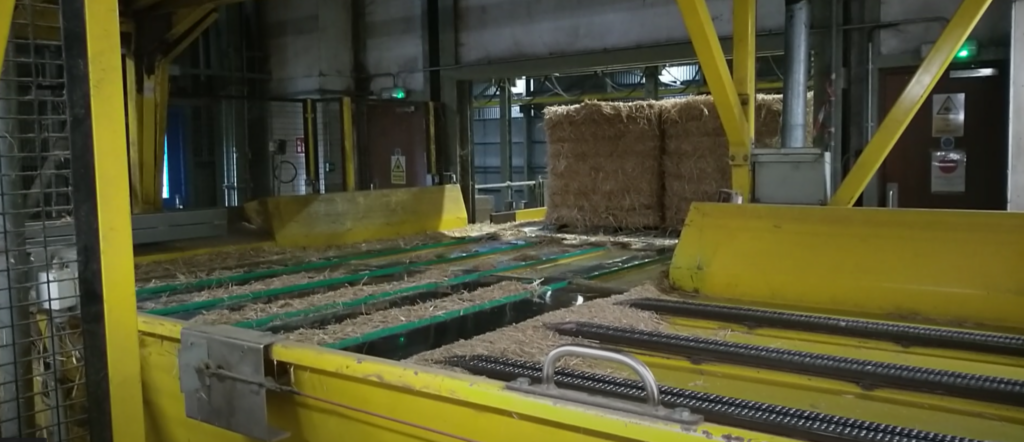
Straw Line Bale monitoring system

Background
We were commissioned by the client to design and implement a comprehensive solution aimed at effectively monitoring the trajectory and position of straw bales as they ascend through enclosed chutes, ultimately feeding into the furnace system. Our task involved the development of a robust monitoring system capable of accurately tracking the movement of each straw bale along its path within the chute network. This involved devising innovative sensor technologies, implementing real-time data collection mechanisms and designing intuitive interfaces for seamless integration into the existing operational framework. Our objective was to ensure precise monitoring and control over the positioning of straw bales, thereby optimising the efficiency and safety of the entire furnace feed process. Through meticulous planning, collaborative efforts and rigorous testing, we delivered a tailored solution that met the client’s requirements while adhering to industry standards and best practices.
Challenge
There was an existing system in place which used retroflective optical sensors. Unfortunately, this system wasn’t very flexible and resulted in frequent bale position failures whenever there was a variance in bale size.
Ultimately any solution we provided would need to be capable of accurately detecting bale position irrespective of the bale size.
Solution
We realised that a digital point detection would be impractical due to the large number of sensors that would be required to provide coverage for all bales sizes. Instead, we decided on a continuous level measurement approach, which we achieved this using compact radar transmitters. The Siemens LR110 with narrow beam angle and flexible installation options was the logical choice.
In order to provide the digital signals required by the station control system, the analogue outputs from the radars have been connected to Status panel indicators that are equipped with trip amplifiers and relay outputs. The relay outputs were then wired directly into existing signal distribution system illuminating the need to alter the control system software.
Result
Our initial trial system was installed back in September 2020 and provided excellent results. This lead to us being provided the opportunity to return and roll out a permanent solution site wide.