
How Turbidity Measurement is Transforming CIP in Dairy Processing
14 April 2026
In dairy manufacturing, clean-in-place (CIP) systems are essential for maintaining hygiene, product quality, and compliance. However, traditional cleaning methods often rely on fixed timings or visual checks — leading to inefficiencies, product loss, and unnecessary downtime.
Today, forward-thinking dairies are turning to real-time turbidity measurement to optimise CIP processes.
At the centre of this transformation is the Exner EXspect 231 NIR Absorption Sensor — a high-precision solution available from Process Instrument Solutions.
The Problem with Traditional CIP Monitoring
Many dairy plants still rely on:
- Timers
- Sight glasses
- Manual checks
The issue? These methods don’t provide accurate insight into what’s actually happening inside the pipeline.
As highlighted in industry reports, this leaves operators “guessing when milk has been flushed out or when rinse water is clean enough”.
The result:
- Product sent unnecessarily to the drain
- Longer cleaning cycles than required
- Increased water, chemical, and energy usage
- Reduced production uptime
The Exner EXspect 231 NIR Absorption Sensor is a high-precision NIR (near-infrared) absorption sensor designed for continuous monitoring of process fluids.
Using advanced optical measurement at 850 nm, the sensor detects changes in turbidity and concentration in real time — regardless of colour.
Key capabilities include:
- Measurement of turbidity, absorption, and concentration
- Real-time detection of product-to-water transitions
- Subtle differentiation between product, rinse water, and cleaning agents
- Continuous monitoring of process conditions
This enables dairies to move from guesswork to data-driven CIP optimisation.
How the EXspect 231 Improves CIP Efficiency
Accurate Phase Detection
One of the biggest challenges in CIP is identifying when the product has been fully removed from the system.
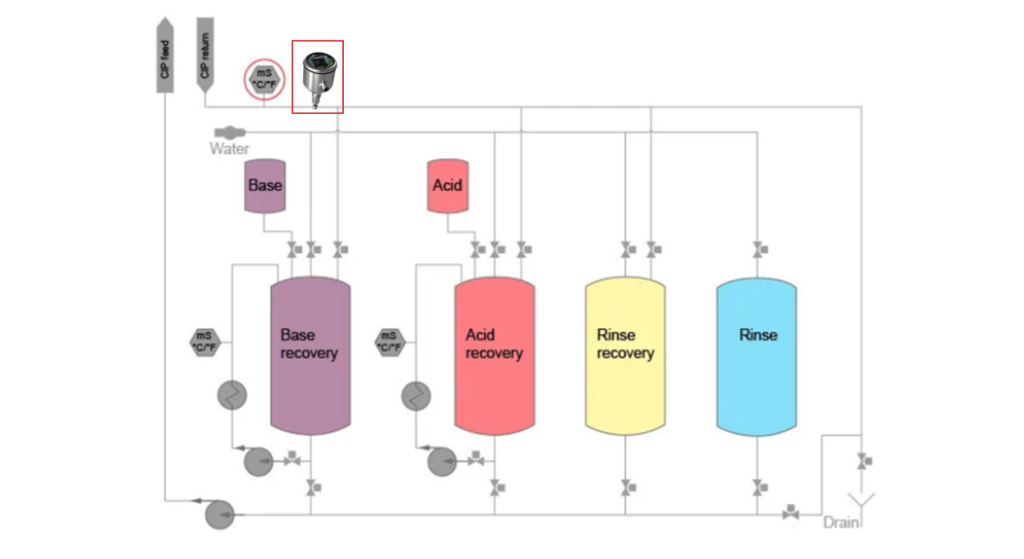
The EXspect 231 provides instant, reproducible turbidity values, allowing operators to:
- Detect exactly when milk is no longer present
- Switch to the next cleaning phase immediately
- Reduce product loss during changeovers
This alone can deliver significant savings in product recovery.
Reduced Cleaning Time and Downtime
With real-time data, CIP cycles no longer need to rely on conservative time-based settings.
Instead, cleaning continues only as long as necessary.
This leads to:
- Shorter cleaning cycles
- Faster return to production
- Increased plant availability
Lower Water, Chemical, and Energy Usage
Over-cleaning is a major source of inefficiency in dairy plants.
By precisely monitoring cleaning effectiveness, the EXspect 231 helps reduce:
- Water consumption
- Chemical usage
- Effluent and disposal costs
According to industry data, these savings can be substantial — often delivering a rapid return on investment.
Improved Product Yield
Every unnecessary flush to drain represents lost product.
With accurate turbidity measurement, dairies can:
- Recover more usable product
- Minimise waste
- Improve overall yield
This aligns directly with one of the biggest commercial drivers in food and beverage manufacturing.
Reliable, Hygienic Design for Food Applications
The EXspect 231 is specifically engineered for hygienic environments, featuring:
- Stainless steel (316L) construction
- Durable sapphire windows
- CIP/SIP compatibility
- Compliance with hygienic standards such as EHEDG
Its robust design ensures long-term reliability even under demanding cleaning conditions.
Designed for Real-World Dairy Applications
Beyond CIP optimisation, the EXspect 231 can also be used for:
- Separator control
- Filter monitoring
- Concentration measurement
- Phase separation in dairy processes
Its compact design, integrated display, and flexible outputs (including 4–20 mA and programmable alarms) make it easy to integrate into existing systems.
From Cleaning Cost to Competitive Advantage
CIP has traditionally been seen as a necessary cost.
But with the right instrumentation, it becomes an opportunity to:
- Increase production uptime
- Reduce operating costs
- Improve sustainability performance
- Ensure consistent, repeatable cleaning
By implementing real-time turbidity measurement, dairies can transform CIP from a reactive process into a strategic efficiency driver.
Why Work with Process Instrument Solutions?
At Process Instrument Solutions, we support food and beverage manufacturers with specialist instrumentation solutions tailored to hygienic applications.
By supplying technologies such as the EXspect 231, we help customers:
- Reduce downtime
- Improve yield
- Optimise CIP systems
- Achieve compliance with industry standards
In modern dairy processing, efficiency and consistency depend on visibility.
The Exner EXspect 231 NIR Absorption Sensor provides the real-time insight needed to optimise CIP processes, reduce waste, and maximise productivity.
For manufacturers looking to improve performance and stay competitive, turbidity measurement is no longer optional — it’s essential.
If you’re looking to optimise your CIP processes and reduce product loss, contact Process Instrument Solutions to learn how the EXspect 231 can support your application.